
Seattle by kayak
Seattle’s Houseboats & Floating Homes: Past, Present & Future
One of the most iconic views from Agua Verde’s dock is the colorful lineup of Seattle houseboats and floating homes across Portage Bay. From a kayak or paddleboard, you can see this historic on-water community the way it was meant to be seen: quietly, up close, and from the water.

The Houseboat View from Agua Verde
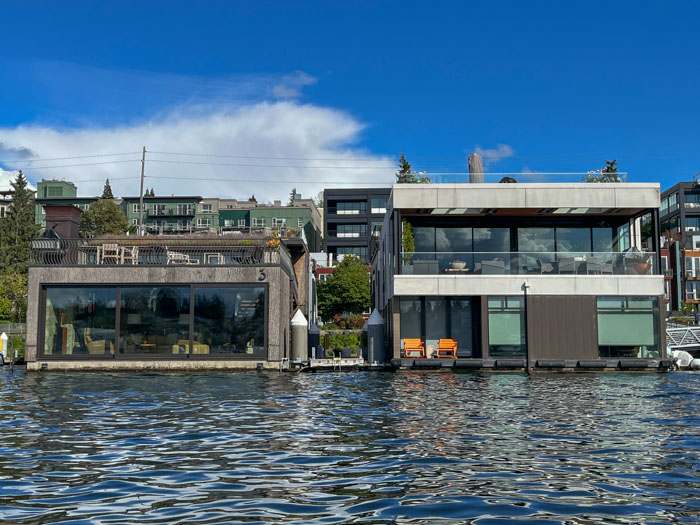
As you take your first strokes off Agua Verde’s dock and get your bearings, the first thing you’ll likely notice is the panoramic view west across Portage Bay: a motley lineup of Seattle houseboats and floating homes bobbing along the far shore. What could be more Seattle than paddling past these liveaboard landmarks on the city’s calm inland waterways?
The scene is wonderfully irregular. There is no single design code that makes these homes look alike. Some are tidy and modern, some are weathered and eccentric, and others look as if they have been patched, painted, loved, and lived in for generations.
Most are one story tall, though many have lofts, upper decks, roof patios, or little dockside sitting areas. Northwest colors dominate — gray, cedar brown, blue, olive green — with the occasional splash of bright paint or tilework to remind you that floating-home culture has always made room for individuality.

What’s the Difference Between a Houseboat and a Floating Home?
In everyday conversation, Seattleites often use “houseboat” as a catch-all term. Technically, though, there is a difference. A true houseboat generally has some means of propulsion or qualifies as a vessel-like residence, even if it almost never moves. A floating home is more like a house on a floating foundation: it is moored in place and would need to be untethered and towed if it were ever relocated.
Houseboats
Often more boat-like in legal or practical terms, houseboats may have marine systems, pump-out needs, and a history closer to Seattle’s scrappier liveaboard past.
Floating homes
Floating homes are residential structures on buoyant foundations, typically connected to utilities and moored in established floating-home communities.
From the water, the distinction is not always obvious — and that is part of the charm. What you notice first from a kayak is the texture of life along the shoreline: roof decks, tied-up dinghies, SUPs lashed to railings, dock gardens, window seats, and residents living with the gentle motion of Portage Bay.
Rules, Ecology & Life on the Water
Seattle’s floating residences may look free-spirited, but the community is shaped by shoreline rules, environmental requirements, and the practical realities of living directly above the water. Wastewater cannot simply be released into Portage Bay or Lake Union. Depending on the residence and moorage, sewage must be connected to the terrestrial sewer system or handled through approved pump-out systems.
There is also an ecological story below the waterline. Many older floating homes still rest on huge old-growth cedar logs that have supported them for decades. These waterlogged timbers may look decrepit from a passing kayak, but they are part of the long-running relationship between Seattle’s built shoreline and its aquatic habitat.

Where to See Seattle Houseboats from the Water
The houseboats and floating homes across from Agua Verde are just one piece of Seattle’s larger liveaboard landscape. The majority are clustered around Lake Union and Portage Bay, where protected inland water, marina infrastructure, and Seattle’s maritime history all come together.
Paddle west from Portage Bay toward Lake Union and you will pass a cross-section of Seattle floating-home culture: older homes with cedar floats, sleek modern structures, colorful dockside details, and some of the city’s most coveted waterfront real estate.
Notable areas to scan from a kayak
- Portage Bay: the easiest floating-home view from Agua Verde’s dock.
- North Lake Union: a classic shoreline for houseboats, docks, and marine activity.
- Roanoke Reef: one of Seattle’s best-known floating-home communities.
- Westlake Avenue North: home to some of the city’s most famous floating residences.
- Gas Works Park shoreline: a wide-water view back toward Lake Union and the skyline.
The most famous floating home of all is the Lake Union residence featured in the 1993 Nora Ephron film Sleepless in Seattle. It sits across the lake from Roanoke Reef, tucked at the end of a storybook dock off Westlake Avenue North. Unless you have an invitation, the best way to see it up close is from a kayak or paddleboard.

A Brief History of Seattle’s Floating Homes
Living on the water is a privilege today, but Seattle’s houseboat history began in a very different place. Early floating homes were practical, rough-built structures associated with logging, maritime work, fishing, boatbuilding, and people who needed inexpensive shelter in a fast-growing frontier city.
By the early 20th century, makeshift houseboats had become a familiar part of Seattle’s waterfront. Some were humble dwellings assembled from scavenged lumber and floating logs. Others became summer homes, workshops, or family residences tied to Lake Union’s working waterfront.

The Great Depression brought another wave of floating residences as people gathered cedar logs, scrap wood, and debris to create temporary homes that often lasted far longer than planned. By the late 1930s, Seattle had thousands of houseboats, and many of the older surviving examples trace their lineage to that era.
After World War II, the communities changed again. Students, artists, workers, and bohemians moved in, but city officials increasingly saw houseboat communities as a problem to be cleaned up. By the 1950s and 1960s, “urban renewal” campaigns demolished many floating residences and replaced parts of the shoreline with over-water apartments and businesses.

Residents fought back. The Floating Homes Association formed in 1962 to defend the liveaboard community and protect a way of life that had become part of Seattle’s identity. Today, Seattle’s floating residences are far more regulated, far more expensive, and far fewer in number — but they remain one of the city’s defining waterfront sights.

How to See Seattle Houseboats by Kayak
The best way to experience Seattle’s houseboats and floating homes is from the water. Launch from Agua Verde Paddle Club on Portage Bay, paddle west toward Lake Union, and follow the shoreline at a relaxed pace while watching for floating homes, working boats, seaplanes, city views, and shoreline wildlife.
Simple houseboat-viewing route from Agua Verde
- Launch from Agua Verde’s dock on Portage Bay and get comfortable before leaving the immediate dock area.
- Look west across Portage Bay toward the floating homes directly across from the Paddle Club.
- Paddle toward Lake Union when wind and boat traffic are manageable.
- Scan the north and east shorelines for houseboats, floating homes, dock details, and older cedar floats.
- Loop back under the University Bridge and return to Agua Verde with a view most Seattleites never get from land.

A kayak or paddleboard gives you a quiet, human-scale way to appreciate the contrast that defines this part of Seattle: tiny homes afloat beneath huge bridges, old cedar floats below modern architecture, and a living waterfront framed by highways, seaplanes, sailboats, and city skyline.

See Seattle’s Floating Homes from the Water
Launch from Agua Verde Paddle Club on Portage Bay and paddle past one of Seattle’s most distinctive on-water communities. Rent a kayak or paddleboard, or explore Seattle’s inland waterways with an Agua Verde guided tour.
Seattle Houseboats & Floating Homes FAQ
Can you see Seattle houseboats from Agua Verde Paddle Club?
Yes. Agua Verde launches from Portage Bay, directly across from a visible lineup of Seattle houseboats and floating homes. A short paddle west brings you toward Lake Union, where even more floating homes can be seen from the water.
What is the difference between a houseboat and a floating home?
A houseboat is generally more boat-like and may have vessel-style systems or mobility in its history. A floating home is more like a house built on a floating foundation and moored in place. From a kayak, both are part of Seattle’s larger liveaboard landscape.
Where is the best place to see Seattle floating homes by kayak?
Portage Bay and Lake Union are two of the best places to see Seattle floating homes by kayak. Launching from Agua Verde puts paddlers close to Portage Bay floating homes, the Lake Union shoreline, Roanoke Reef, and classic views toward Gas Works Park and the Space Needle.
Can you paddle near the Sleepless in Seattle houseboat?
The famous floating home from Sleepless in Seattle is on Lake Union off Westlake Avenue North. Paddlers can view the area from the water, but should always respect private property, keep a reasonable distance, and avoid lingering at private docks.
Are Seattle’s houseboats private homes?
Yes. Seattle’s houseboats and floating homes are private residences. Enjoy the architecture and history from the water, but paddle respectfully, keep voices low near homes, and never enter private docks or moorage areas.
What should I bring for a houseboat-viewing paddle?
Bring weather-appropriate layers, sun protection, water, a waterproof phone pouch, and a camera or binoculars if you want a closer look from a respectful distance. Agua Verde provides the rental boat or board, life jacket, and basic paddling gear.